the beirut rs

  1973 Carrera RS 2.7 M471 Sport ‘Lightweight' 

#911 360 1247


Beirut, the Lebanese capital, has been the setting for some of the most moving and tragic stories of modern times. Who could easily forget seeing news footage of much of this once peaceful country reduced virtually to rubble by a vicious 15-year civil war?  And yet still this remarkable place seems to tug at our heartstrings. In mid-2006, a decade and a half after the end of that appalling war, the world was forced to witness the seemingly wanton destruction wrought on a then slowly recovering nation by a vengeful Israel, in retaliation for what it claimed at the time were Syrian-backed Hezbollah rocket attacks launched from within Lebanon's borders. And as recently as mid-2007 came - albeit on a rather smaller but no less poignant scale - the frankly incredible tale of the discovery of this long buried ex rallying 1973 Porsche 911 Carrera RS 2.7 ‘Lightweight'.

The car discovered The car discovered The car discovered

The story - which sadly, requires as much understanding of the Middle East problem as is possible to acquire within just a few lines - begins in the early 1970's, when the Popular Front for the Liberation of Palestine had hijacked a number of western airliners, blowing 3 up in the Jordanian desert. The Lebanon had thus far avoided being drawn too far into this nascent conflict, and for many people life in this easy-going former French dependency carried on much as it had before. It certainly must have done so for the original owner of this RS, because some time in early May 1973 he took delivery of this then brand new car. And almost immediately, pressed this now iconic RS model into service to enable him to progress to the next stage in his competition career. Equipped as you see it now, plus little more than a factory-fitted undertray/sump guard, it embarked on a career that would ultimately see it survive more or less unscathed the most intimidating of odds, the most hazardous of circumstances. Starting with a series of both national and international events in the area, including the Beirut-Damascus Rally.

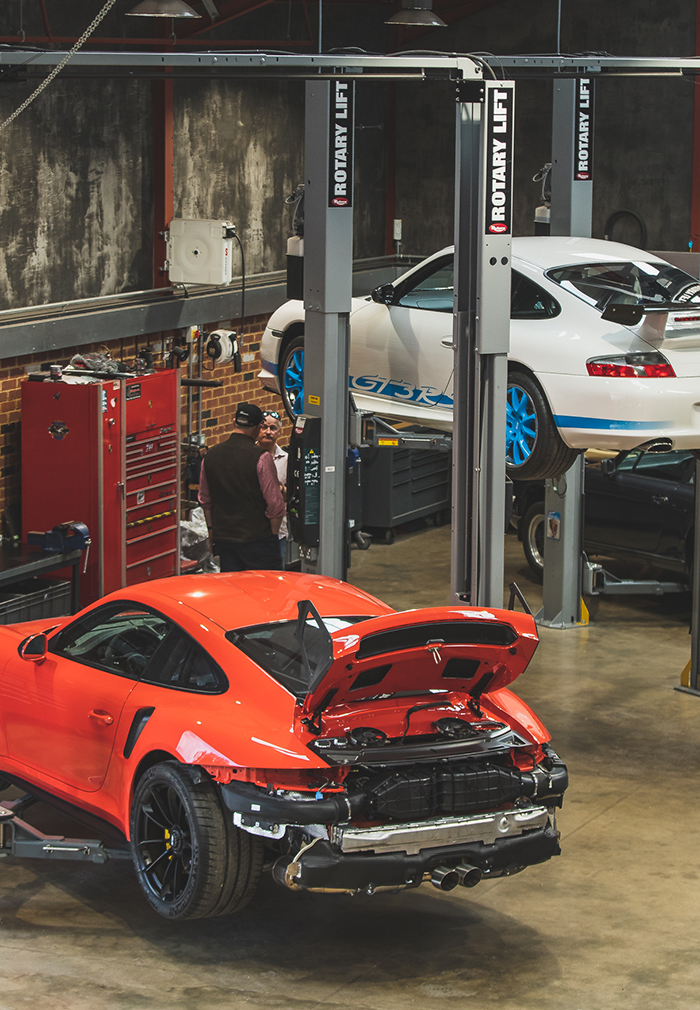
The car back at Autofarm - Showing damage to the front boot area

But by the early 1980s the civil war in Lebanon, which had been growing in intensity since the late summer of 1975, was beginning to spiral completely out of control. In June 1982 Israel invaded Lebanon, with the stated aim of destroying the Palestine Liberation Organisation's leadership, and by the end of August it appeared to have achieved that goal, with the departure of PLO leader Yasser Arafat. But this was quickly followed by the Christian Phalangist militia carrying out massacres at the refugee camps in West Beirut, and the entire country was plunged into an even more vicious and bloody struggle which would take fully eight years to resolve. It was definitely no time for Lebanese motorsport, and this rally RS was placed in storage, its competition career effectively over.

Popping the roof out

In the Lebanon, now a full-blown war zone, new and far more dangerous challenges appeared, and rallying was replaced by our hero signing up as a voluntary ambulance driver for the Lebanese Red Cross, predictably difficult and dangerous work. In the summer of 1985 he finally agreed to family appeals to call it a day, but then in August that year, on what was scheduled to have been literally his last run to the refugee camps, his ambulance disappeared without a trace. Either killed during some sort of attack, or possibly taken hostage and subsequently murdered, he has not been seen since.

Refitting the rebuilt engine

And but for the extraordinary hand of fate, this might well have proved to be the case for his 2.7 RS, too. With many other things on his family's minds, this RS, was slowly but surely forgotten while the building (and, indeed, the city itself) largely disintegrated around it. At some point during the next 20 years the block sustained significant damage during a mortar attack, causing part of a wall to fall on the hapless Porsche. Somehow, though, both the structure and the car inside it survived: neglected, overlooked, abandoned, discarded - and yet paradoxically in probably one of the safest places it could possibly be. Who on earth would think of looking for an RS in the middle of a battlefield?

Final detailed build

Gradually, though, Beirut started to return to what might be called normal, and ultimately building work uncovered the battered car. Good fortune found someone who knew of the family's whereabouts, now living abroad. But knowing relatively little about Porsches, less about classic 911s, and less still about the likely value of a genuine one-owner ‘numbers match' RS with only 47,000km (29,000 miles) on the clock, they assumed it to be near valueless. But then a chance conversation with some old friends living here in England - Don Shead and his family from Hampshire - set things in motion remarkably quickly.

First drive after completing build at 3am

Don himself had long been an Allard enthusiast rather than a dedicated Porsche fan, as such, but at the same time he knew enough about 911s to suspect that even given its rather offbeat and quite possibly still hazardous location, and a description that was sketchy at best, the car was probably worth a look. That was soon corroborated by a phone call to fellow Allard man Josh Sadler at Autofarm - who had trouble containing his amazement - and in March 2007 Don's son, James, made what would be his one and only trip to Beirut to find out the truth, awful or otherwise, for himself. Reaching the car for the first time was, as James described, one of those classic heart-in-your-mouth moments that are probably better remembered over a beer in the pub than actually experienced. ‘I was clenching my teeth and literally willing it to be what by then we all hoped it was. It just had to be an RS!  Josh had already told me what I should be looking for,' adds James. ‘You know, chassis and engine numbers, the details like thinner Glaverbel glass for the side windows, that sort of thing. I e-mailed over dozens of photos, and it didn't take him long to come back with the right answer - it really was an RS Lightweight - and I knew then that whatever might prove to be the car's mechanical and structural condition we had struck pure gold. How many more people are ever likely to find a 911 like this, and in anything like these circumstances? Never mind one as original and, despite its initial rather shabby appearance, as well preserved as this one is.'

At the start of the Tour des Alpes 2008

There followed yet another step in the fairy tale, when, recognising that whilst the family had no idea on the car's value, to ensure their long term enjoyment of ownership of a such a unique vehicle the Sheads decided they must pay a fair price for it.  And whilst that substantial figure must remain undisclosed, suffice it to say that their honesty and generosity were immediately matched by the family, who decided unanimously to donate the entire proceeds of the sale to the Lebanese Red Cross, which subsequently bought not just one but two brand-new ambulances with which to carry on the work that had cost the head of the family his life.  ‘A fantastic gesture that makes you realise just how much we take for granted here in Europe,' says a still emotional James. ‘Truly humbling.'

Car and trophy - Best historic car

But what to do with it now? Clearly the car had survived both its competition career and subsequent incarceration remarkably well, but was no less clearly going to need some expert attention. The roof, for example, had been partially crushed by the falling masonry (smashing the laminated windscreen in the process, which had then fallen onto the gear lever and eventually moulded itself into a neat little heap on the floor). One thing was already certain, however. The RS would not be restored in the conventional sense. ‘It might seem perverse,' confesses James, ‘but we wanted to keep the patina it had acquired. So whilst Autofarm have done a total mechanical rebuild for us (including engine, gearbox, fuel lines, brake lines, all electrics, suspension, etc), we wanted to do no more to the body than was absolutely necessary. Which meant pushing out the dent in the roof - you couldn't even sit in the car otherwise, and rust treating all the exterior and covering it in a clear coat lacquer. Other than that it remains more or less in the condition in which it was found.' 

The Beirut 911 RS in the Alps

This RS then re-emerged to a new era of competition life, entering the 2008 ‘Coup des Alpes' Alpine Rally, and winning the trophy for the Most Historic Car.  None of us will ever actually know if there really is some sort of afterlife - until or unless we happen to get there ourselves. But it's comforting to imagine that the spirit of a brave Lebanese enthusiast, who gave up his own life helping others, might have been looking down on his reborn rally car and smiling his approval.


1973 RS 2.7 M471 Sport.

#911 360 1247

With acknowledgements to Chris Horton and 911 & Porsche World, January 2008 issue.